Community Partner
Data Center Deals
Distribution Utility-Partnered Power: Guzman’s data center deal philosophy where the distribution utility (and the community it serves) is at the heart of the deal.
Community First
What Distribution Utility-Partnered Power (UPP) looks like:
Data Center
- Brings the Load
- Pays Their Way
- Seeks Speed to Power
Guzman Energy
- Assembles the Generation Portfolio
- Executes the Commercial Agreements
- Manages Grid Connectivity
- Manages Operations Around the Clock
- Absorbs the Risk
Distribution Utility
- Captures Hosting Revenue
- Unlocks Economic Value for Community
- Power Reliability Protected
The Benefits Stay Local. So Does the Protection.
Community Value & Protection
Guzman’s risk management allows local communities to realize the full benefits of serving a data center. With Guzman, the distribution utility is always a partner, never a bystander.
800–1,200
construction jobs
Jobs
Hundreds of high-wage construction roles over 12–24 months, then 100-200 permanent operations jobs paying $70,000–$120,000 for 15+ years.
$3–$30M
property tax, per year
Tax Base
A campus can contribute millions in annual property tax revenue. The range depends entirely on state tax policy and local abatement levels.
$12,000
per MW, per year
Utility Revenue
A hosting fee tied to power delivery. On a 500 MW campus that is over $6 million a year in administrative fees for the local utility.
Figures vary by project and jurisdiction. Sources available on request.
One Partner, Every Stage
Data centers need support across every stage of energy procurement. Guzman offers that as a single partner, delivering continuity from portfolio construction to long-term energy management — not constrained by specific sites, assets, or utility service areas. And we are an ongoing partner to the distribution utility throughout the term, preserving the business model that exists today.
Stage 01 — Portfolio Construction
Best-Fit, Least-Cost Resource Assembly
We design optimized generation and storage portfolios across technologies, developers, and geographies — unconstrained by ownership or any single developer relationship.
Stage 02 — Contract Execution
Power Purchase and Power Supply Agreements
Bundling a power supply portfolio that meets the capacity, energy, renewable and market access needs of the load.
Stage 03 — Interconnection Support
Full-Service Through Interconnection
We guide parties through grid interconnection from site selection to energization.
STAGE 04 — UTILITY FOCUS
Decades of Experience and Trusted Reputation
We have 13+ years experience partnering with distribution utilities. We understand and preserve their business models, and carry a reputation for delivery that pure commercial players cannot replicate.
Stage 05 — 24/7 Operations
Excellent Track Record Serving Customer Load
Real-time scheduling, dispatch, hedge execution, and load balancing around the clock — firm, shaped power delivered to the distribution utility 24/7.
Protecting the Community
A large load brings three kinds of exposure to the distribution utility — commercial, power supply, and operations. There are more options than islanding a load off grid with behind the meter generation or folding the risk of new large load into the utility.
Guzman insulates the distribution utility from large load power supply risk while connecting to the grid and operating within the distribution utility jurisdiction.

Key Element 1
Commercial
Guzman Negotiates definitive Purchase Power Agreements and then designs and enters into a Power Supply agreement customized to the utility.
How Guzman manages it
Resource Planning & Procurement
Supply portfolio developed on “best-fit, least-cost” principles. Guzman secures advanced, high-quality projects through Power Sales Agreements or other mechanism.
Power Sales Agreements Negotiations
Guzman serves customers under a holistic Power Supply Agreement that manages a broad portfolio of assets.
Key Element 2
Power Supply
Providing firm, shaped power — energy, capacity and other attributes, to match the customer’s load and market and contract requirements.
How Guzman manages it
Asset & Customer Onboarding
Guzman ensures the generating assets and the load customer have completed all tasks needed to participate in the wholesale market.
Wholesale Power Management
The customer does not have to worry about project CODs — Guzman covers the obligations.
Key Elements 3
Operations
24/7 Operations for day ahead, real time, congestion management, market participation and other operational services.
How Guzman manages it
Daily Operations and Optimization
Guzman manages all day-ahead and scheduling obligations.
Power Sales Agreements Administration
Ample experience managing supply- and load-side contracts.
Power Supply Solution:
Under a pass-through structure, the distribution utility keeps its existing business model and its relationship with its members. It continues to provide retail electric service to the data center while its existing membership stays isolated from the risk.
Wholesale
Guzman Energy
Provides full requirements — shaped wholesale power — from initial ramp to stabilized consumption.
Retail
Distribution Utility
Distribution utility (or their Generation and Transmission Cooperative or Joint Action Agency) pay Guzman for wholesale power, provides retail power received to data center, and capture administrative fees from the data centers. Preserves the existing business model.
Large Load
Data Center
Data Center pays distribution utility per Rate Schedule to include Guzman Power Sales Agreement costs and distribution utilities costs.
The Structure and Responsibilities
GE
Guzman Energy
Wholesale provider · market participant (supply)
- Power Sales Agreements management
- Resource Adequacy compliance
- Settlements & nodal price risk
- TCR management
- Sell-side and buy-side credit
G&T / JAA
G&T Cooperative or Joint Action Agency*
Wholesale provider to distribution utility
- Market participant (load)
- NITS customer
- Load responsible entity
- Billing
* “if applicable” Guzman or the distribution utility can play these roles as necessary or preferred
DU
Distribution Utility
Retail provider to the data center
- Retail service & delivery
- Billing obligations
- Keeps its certificated right to serve
DC
Data Center
Retail customer of the distribution utility
- Minimum must-take
- Collateral & buy-side credit
- Interconnection upgrade credit
- Interconnection & network upgrades
Common Questions
The questions members and neighbors actually ask, answered in plain language.
What are the economic benefits to local communities?
Data centers generate broad economic benefits for host communities, including temporary construction-driven growth, permanent skilled jobs, workforce development, infrastructure upgrades, and increased property tax revenue. By contributing a significant share of local taxes, data centers provide jurisdictions with greater flexibility to fund public services and manage tax rates for residents and businesses.
Do data centers create a lot of noise?
Once operational, the noise generated at the data center will come from the cooling systems and intermittent testing of back-up generators. This noise is typically less than the noise generated by traffic along neighboring highways. Setbacks, buffering and other natural site features will limit noise impacts. Noise studies are being performed to ensure site design accounts for sensitive receptors and noise ordinances.
Will the data center use all the water?
No. Many data center developers are committing to no ongoing water consumption for cooling. Closed-loop cooling systems are being used which will require a one-time fill. After that, water use is similar to an office building or hotel for regular water consumption (sinks, toilets, etc.).
How many jobs do data centers create?
A 500–1,000-megawatt data center is estimated to create more than 1,000 construction jobs and up to several hundred full-time operations jobs. These are high-paying positions such as data center technicians, network engineers, and IT support staff that often do not require four-year university degrees.
Will the data center cause my electricity bill to increase?
Guzman designs power supply so that the incumbent customers do not carry cost and the distribution utility is derisked. With the correct cost allocation principles (cost causation), distribution utilities can ensure new customers do not negatively impact existing ratepayers. Data centers are now being required to fund the transmission and generation upgrades needed to serve their load, making these projects fully self-sustaining without shifting costs to other customers.
What are data centers and why do we need them?
Data centers are highly secure buildings filled with computer servers that store, process, and move data around the world — they’re where the internet lives. Instead of your data living only on your phone or computer, data centers safely store it and keep it available whenever you need it. Nearly everything we do today depends on them, from banking and healthcare to schools and modern farming technology.
What are the basics of a data center campus?
Data Center 101: What Are Data Centers and Why Do We Need Them?
A data center campus is more than just server buildings. The site is fenced and gated, with a guard house checking in every vehicle so access stays controlled and predictable. Inside, the data halls that house the servers are built in phases, each paired with an equipment yard for cooling and backup power, screened by sound walls to contain noise. Power arrives through a transmission line and substation sized for the full build-out, while access roads, fire lanes, and a stormwater pond round out the site.
Data Centers Are the Backbone of Our Digital Economy.
As more homes, farms, and businesses rely on digital tools, the need for reliable data centers grows.
These facilities power almost everything we do in today’s world — all of it depends on them.
Banking
Healthcare
Education
Farming Technology
Government Services
Business Operations
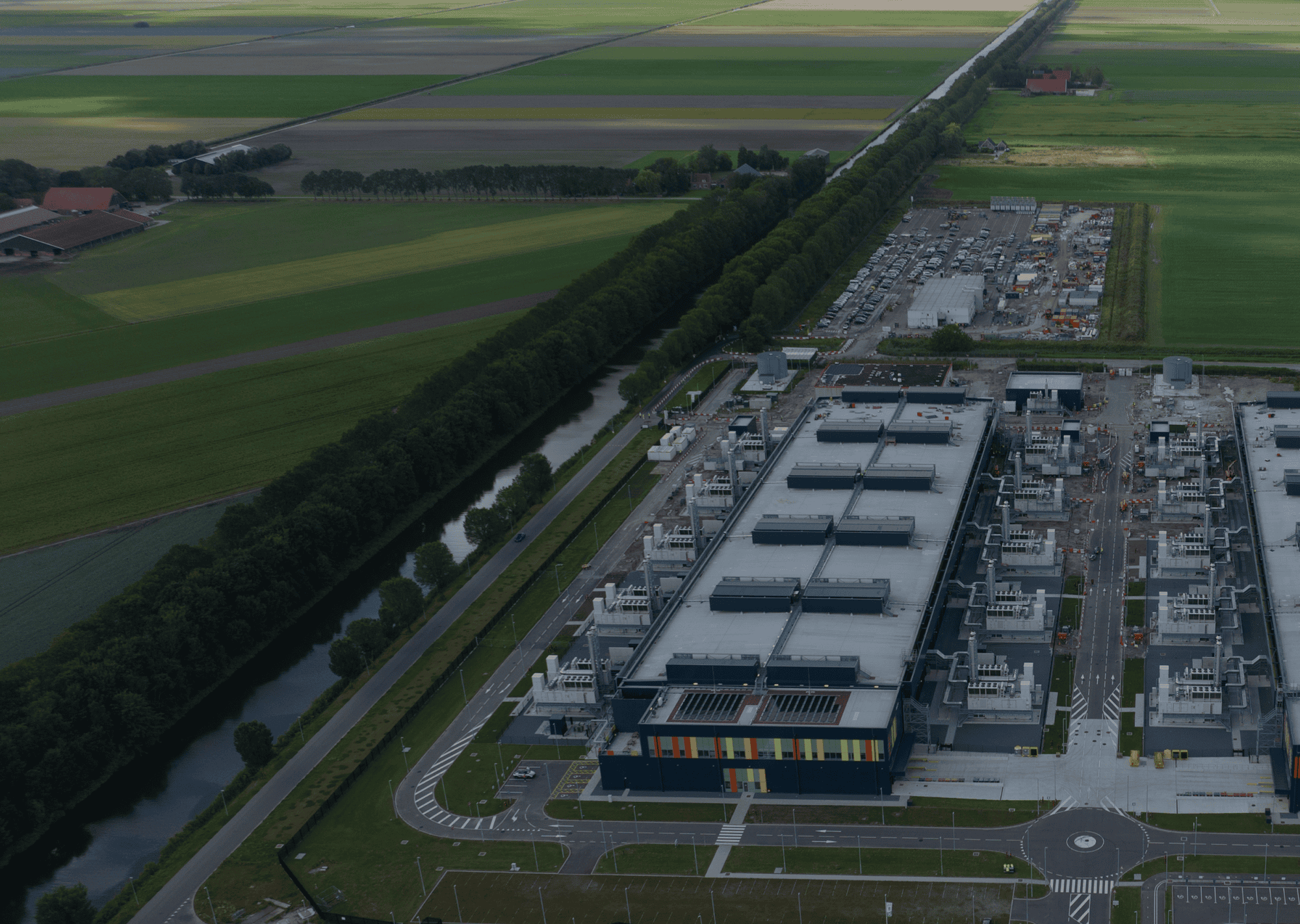
A Data Center Campus
A Data Center Campus
Data centers are more than just server buildings.
Component list after ULI, Local Guidelines for Data Center Development. Illustration is schematic, not a specific site.
Make Large-Load Growth Work for the Utility and the Community.
One conversation covers portfolio, contracts, interconnection, and 24/7 operations. Bring us the load and we will bring the tailored solution.
One Name, Many Scales
The transformational loads — hyperscale, colocation, and AI — buy speed to power and certainty of delivery. That is the conversation a distribution utility is being pulled into.
TRANSFORMATIONAL · STEP-CHANGE LOAD AI / HPC 100MW – 500MW+
Purpose
AI model training & advanced compute
Power Need
Long-term, scalable capacity with flexibility to expand. Increasing preference for clean or structured power solutions.
What Matters
Speed to power · scalability


TRANSFORMATIONAL · STEP-CHANGE LOAD Hyperscale 100MW – 1GW+
Purpose
Massive, cloud-driven campuses built and operated by hyperscalers
Power Need
Large, concentrated load with step-function ramp
What Matters
Speed to power · certainty of delivery



TRANSFORMATIONAL · STEP-CHANGE LOAD Colocation 100MW – 500MW+
Purpose
Facilities that lease space and power to multiple customers
Power Need
High reliability and uptime requirements — near 24/7, minimal interruption
What Matters
Cost predictability · certainty of delivery


TRADITIONAL · INCREMENTAL LOADEnterprise & edge <1MW – 20MW
Purpose
Privately owned sites for a single company’s internal use, and small distributed sites close to end users
Power Need
Stable and predictable, or distributed and location-specific
What Matters
Cost control · reliability · proximity